
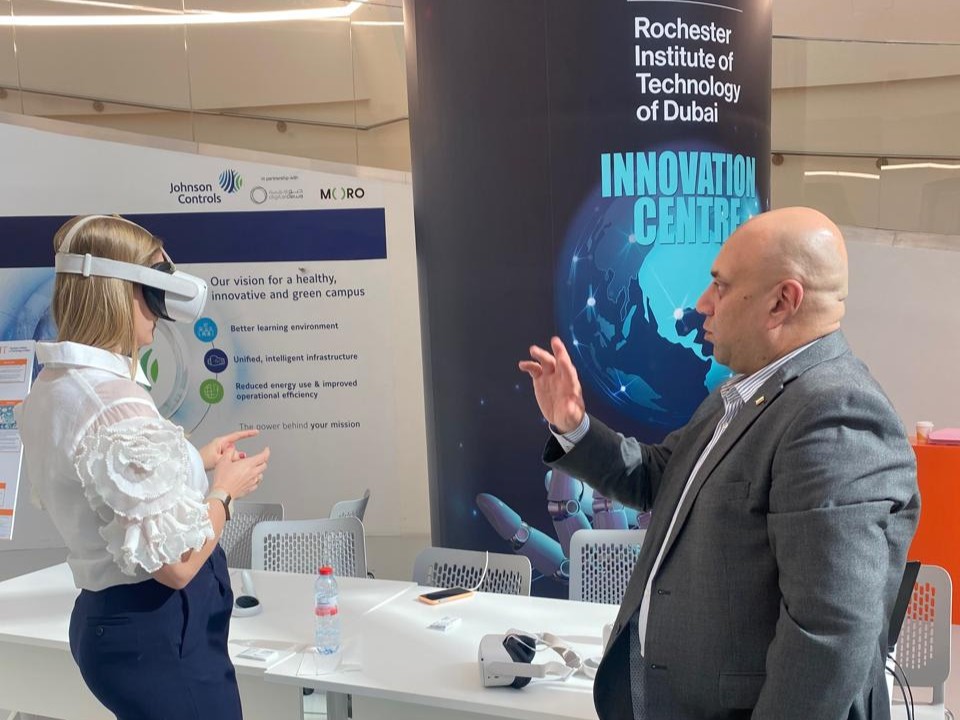
PsycReality took centre stage at Rochester Institute of Technology Dubai’s Annual Psych Day, delivering a deep-dive workshop that introduced psychology students and faculty to the evidence-based science powering VR-driven mental health care.
The PsycReality team was invited to present at one of the region’s most anticipated academic events, bringing its immersive technology platform directly into the hands and minds of the next generation of mental health professionals. The workshop moved well beyond a product demonstration — it was a scientific conversation about why and how virtual reality works as a therapeutic tool.
More than a headset: a science-based system
At the heart of the session was a clear message: PsycReality is not a technology novelty. The team walked attendees through the neurological and psychological mechanisms that make immersive environments uniquely effective from controlled exposure therapies for specific phobias and anxiety disorders, to the measurable restoration effects that VR environments produce on the overworked nervous system.
The workshop covered PsycReality’s full clinical scope. Beyond phobia and anxiety treatment, the team explained how immersive technology addresses a growing and often overlooked challenge in mental health: professional burnout. By creating physiologically calibrated virtual environments, PsycReality’s platform actively promotes nervous system regulation, stress recovery, and sustained mental wellness, all grounded in peer-reviewed science rather than anecdotal benefit.
“What we do isn’t a random technique, it’s a structured, science-based system developed by PsycReality. Every environment, every session protocol, is designed around how the brain and body actually respond to immersive stimuli.”
A partnership born from curiosity
The response from RIT Dubai’s academic community was immediate. Faculty and researchers, engaged throughout the session, expressed strong interest in a formal collaboration. What began as a single workshop quickly evolved into an ongoing research partnership, one that has since brought PsycReality’s real-world clinical applications together with RIT Dubai’s academic rigour.
Under this continued partnership, RIT Dubai psychology researchers have conducted systematic literature reviews across two high-impact clinical areas, contributing to a growing body of evidence that underpins PsycReality’s therapeutic approach. The findings from these reviews have been consolidated and jointly published as white papers, available to the wider mental health and academic community.
Published research areas
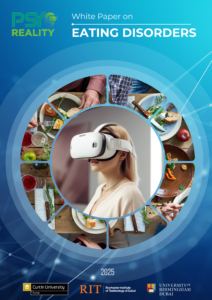
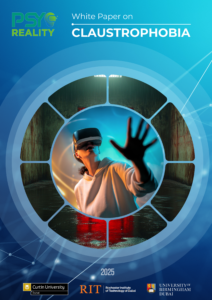
Both areas represent conditions where immersive technology holds particular promise but where clinical evidence has historically lagged behind practitioner interest. The collaborative reviews address that gap — helping establish a more robust scientific foundation for VR-assisted intervention in each domain.
Shaping the future of mental health education
The RIT Dubai partnership represents more than a research collaboration — it is a signal of where mental health education is heading. By embedding clinical-grade VR science into academic programmes, PsycReality and RIT Dubai are helping ensure that tomorrow’s therapists and psychologists graduate with both the theoretical grounding and the practical understanding to deploy immersive tools confidently and responsibly.
For PsycReality, engagement with academic institutions like RIT Dubai is a core part of its mission: to move VR therapy from the fringe to the mainstream of evidence-based mental health care — not through marketing, but through science, publication, and partnership.